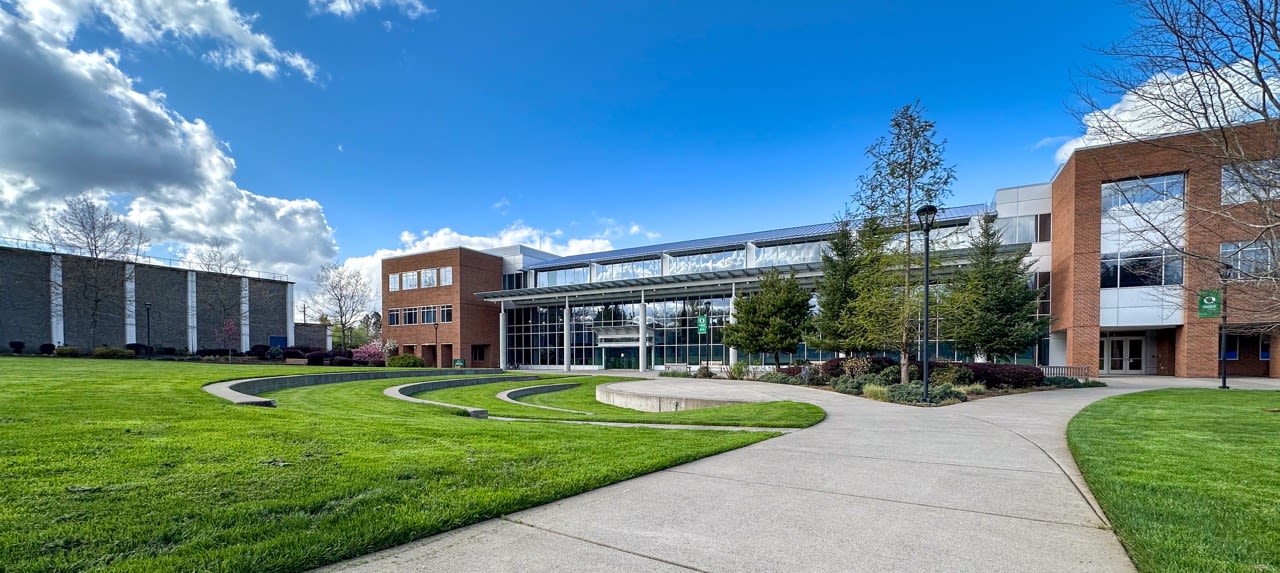
Design for All: UO Portland’s Library Design Studio
A partnership with Bora Architecture & Interiors puts students at the center of one of civic architecture’s most complex design challenges.


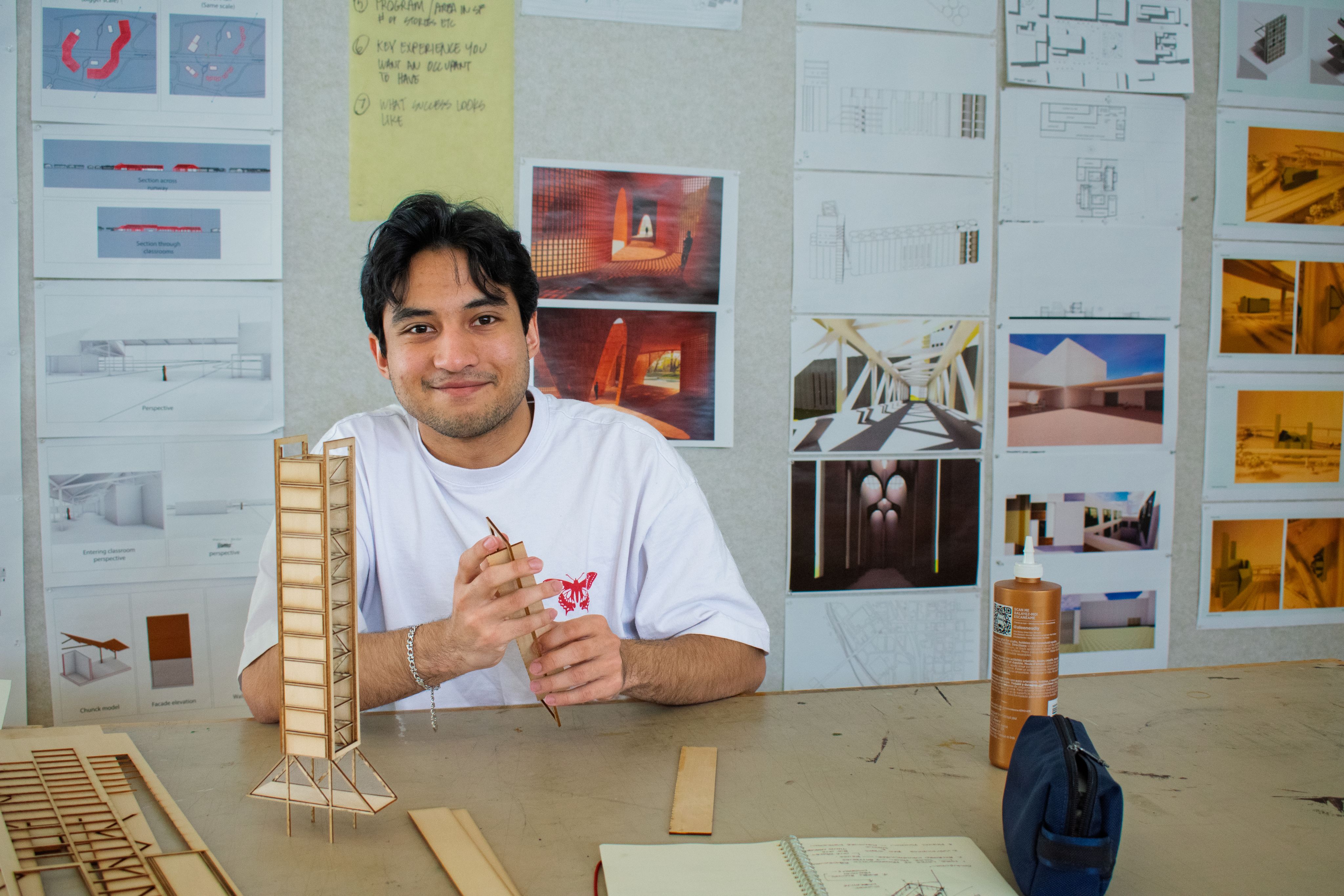
Architecture student Gabriel Alvarado in Highland Hall on the UO Portland Campus.
Architecture student Gabriel Alvarado in Highland Hall on the UO Portland Campus.
Gabriel Alvarado's interest in architecture came from noticing things in his own home that seemed out of place.
Growing up in a Honduran city shaped by rapid urbanization, Alvarado spent his childhood noticing how buildings failed the people inside them — over-reliance on air conditioning, materials that absorbed heat, buildings indifferent to their surroundings. "It's hot in Honduras year-round. Why wasn't that considered? Nothing was designed around its context."
Alvarado channeled that curiosity into purpose. How could structures integrate into the environment and work with natural elements? As a bachelor of architecture student at the University of Oregon Portland, he got to put this theory into action by designing a library that blends into the landscape, rather than imposing itself onto it.
The Library Design Studio is a partnership with Bora Architecture and Interiors, a prominent Portland-based firm working to reimagine community-centered civic design. The studio challenges graduate and upper-level bachelor students to design community libraries from the inside out, working alongside industry professionals on questions that go far beyond aesthetics.
“As libraries continue to evolve, we have an opportunity to strengthen civic infrastructure—reframing them as places that support not only learning, but also belonging and access. That shift is reshaping how we design, who we design with, and how we define success.”
A LIVING LABORATORY
The collaboration is grounded in a simple but powerful premise: the best way to train the next generation of architects is to put them in the room with professionals already doing the work.
“Libraries are at the forefront of what a civic building can be for the future,” said Justin Fowler, assistant teaching professor and director of UO’s Portland Architecture Program. Today’s public libraries are among the most complex design challenges in civic architecture — functioning simultaneously as community centers, afterschool programs, places of respite for the unhoused, and inclusive spaces for people of all abilities.
“You have to serve diverse groups of children and adults in the same space, but in different ways,” Fowler said. “Sensory rooms, breakout spaces, clean bathrooms, public art programs — the modern library is not a bookstore. It’s the front line of what a city owes its residents.”
Alvarado saw it firsthand. “From the site visits, it almost feels like going there to read is the last thing people do,” he said. “There are classes like yoga and dance and events. The function of a library is much more of a community tool.”
Bora Architecture and Interiors has spent years working at that frontier. Recent projects for the Multnomah County Library system including new construction of the Holgate and Midland branches and historic renovations at Belmont and St. Johns have made the firm a leader in exactly the kind of community-centered design the studio is organized around. Students worked with two hypothetical sites modeled with real communities, wrestling with what it means for a library to truly reflect and serve the people who will use it.
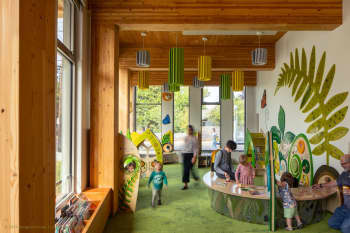

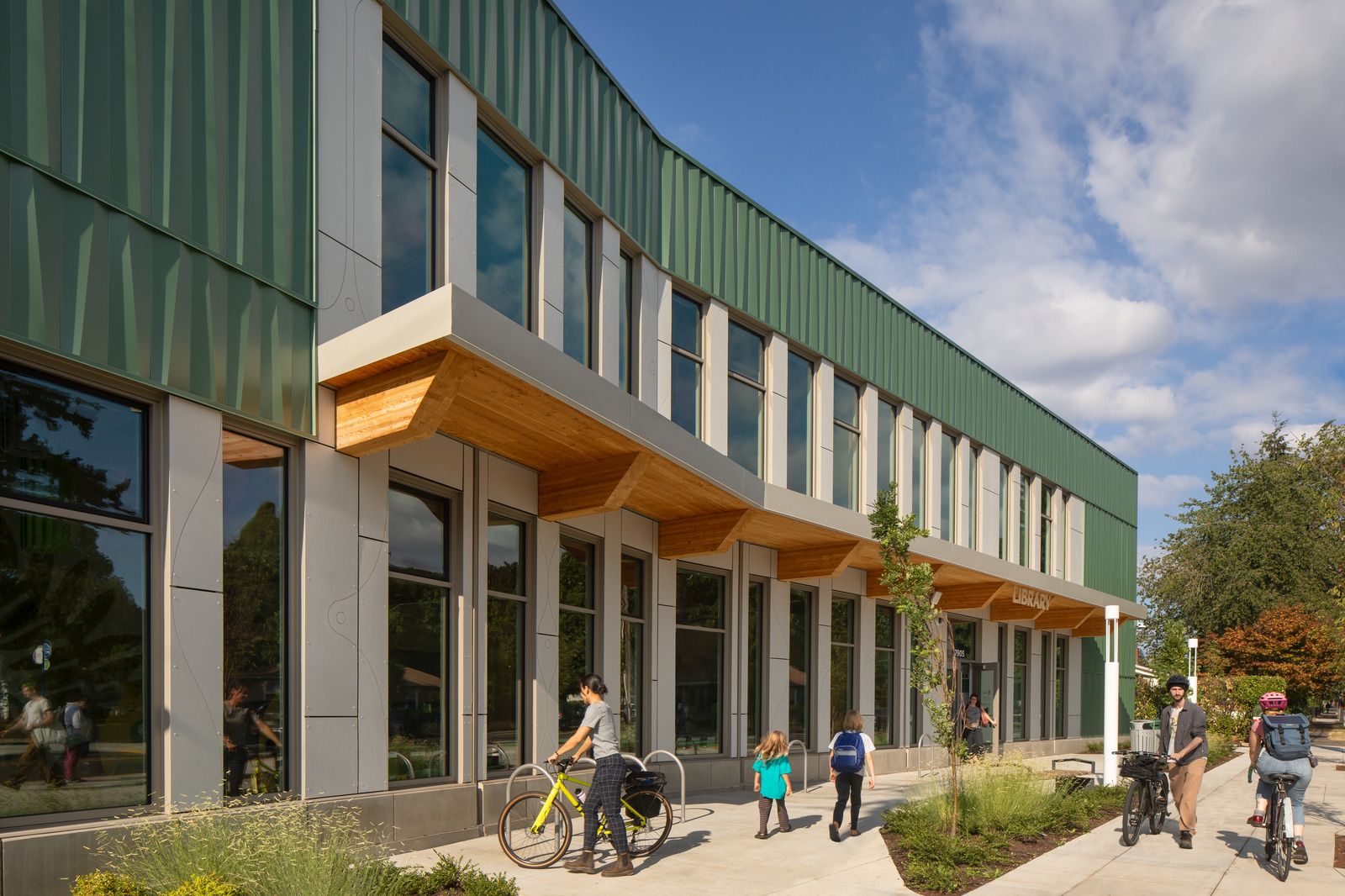

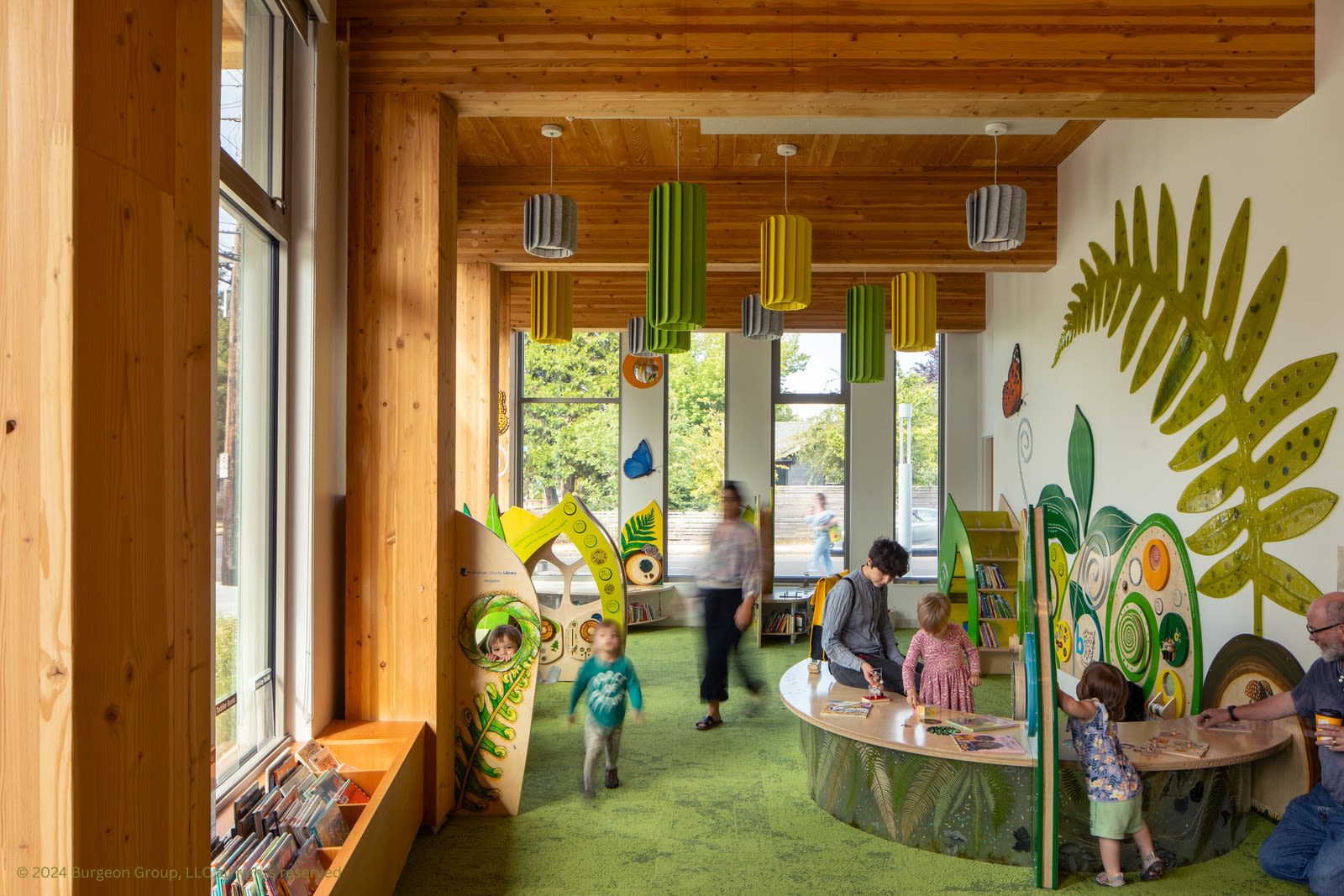
"I learned how a library can meet so many needs. It’s not just a place to get books and read."

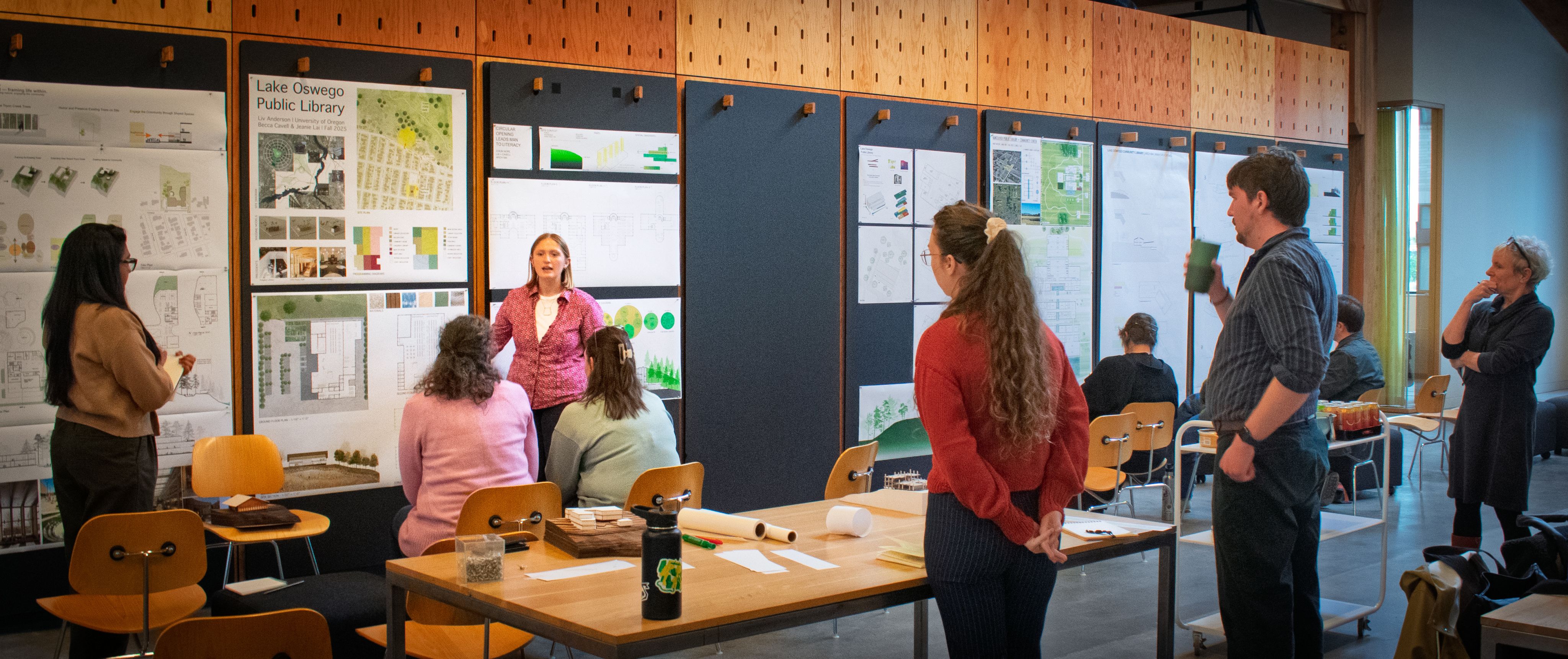
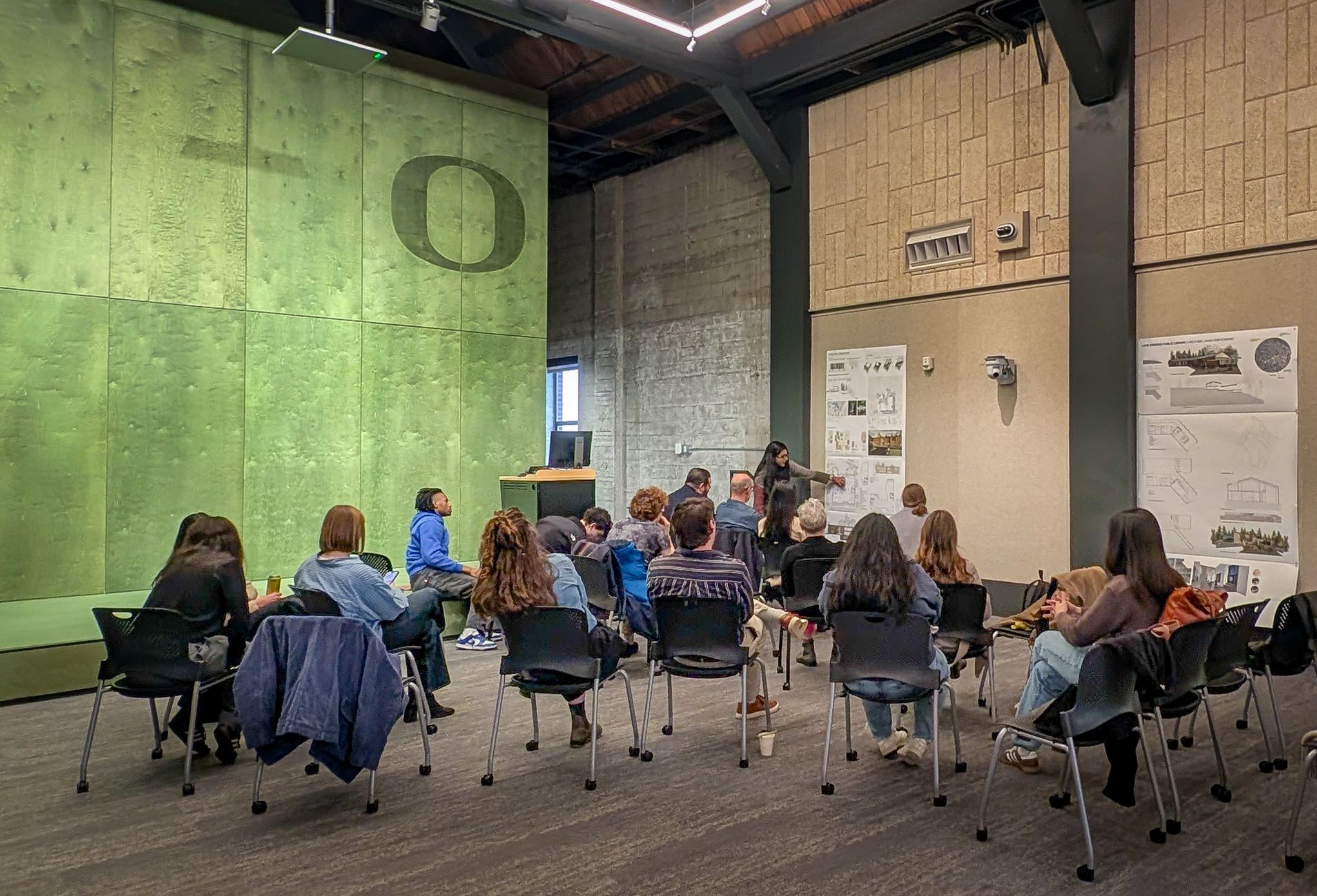
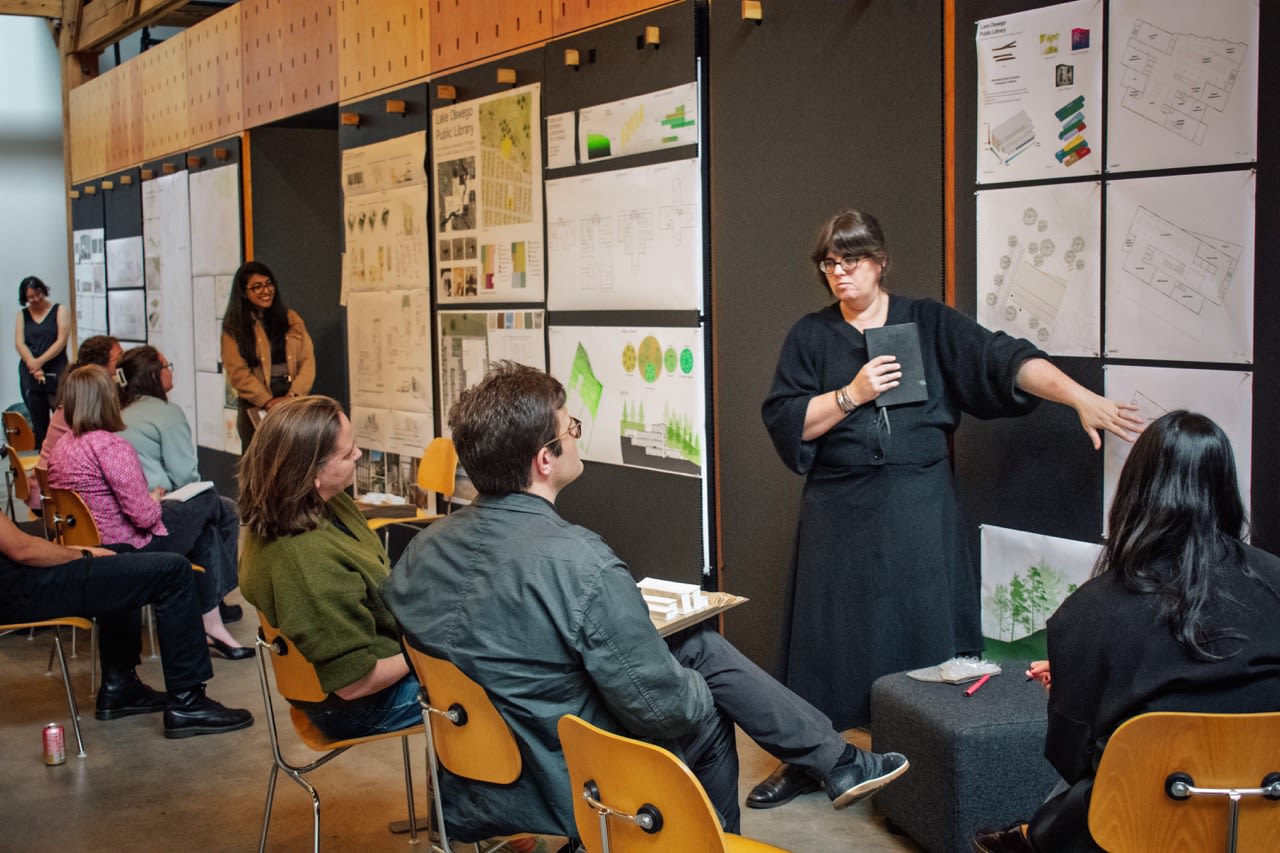
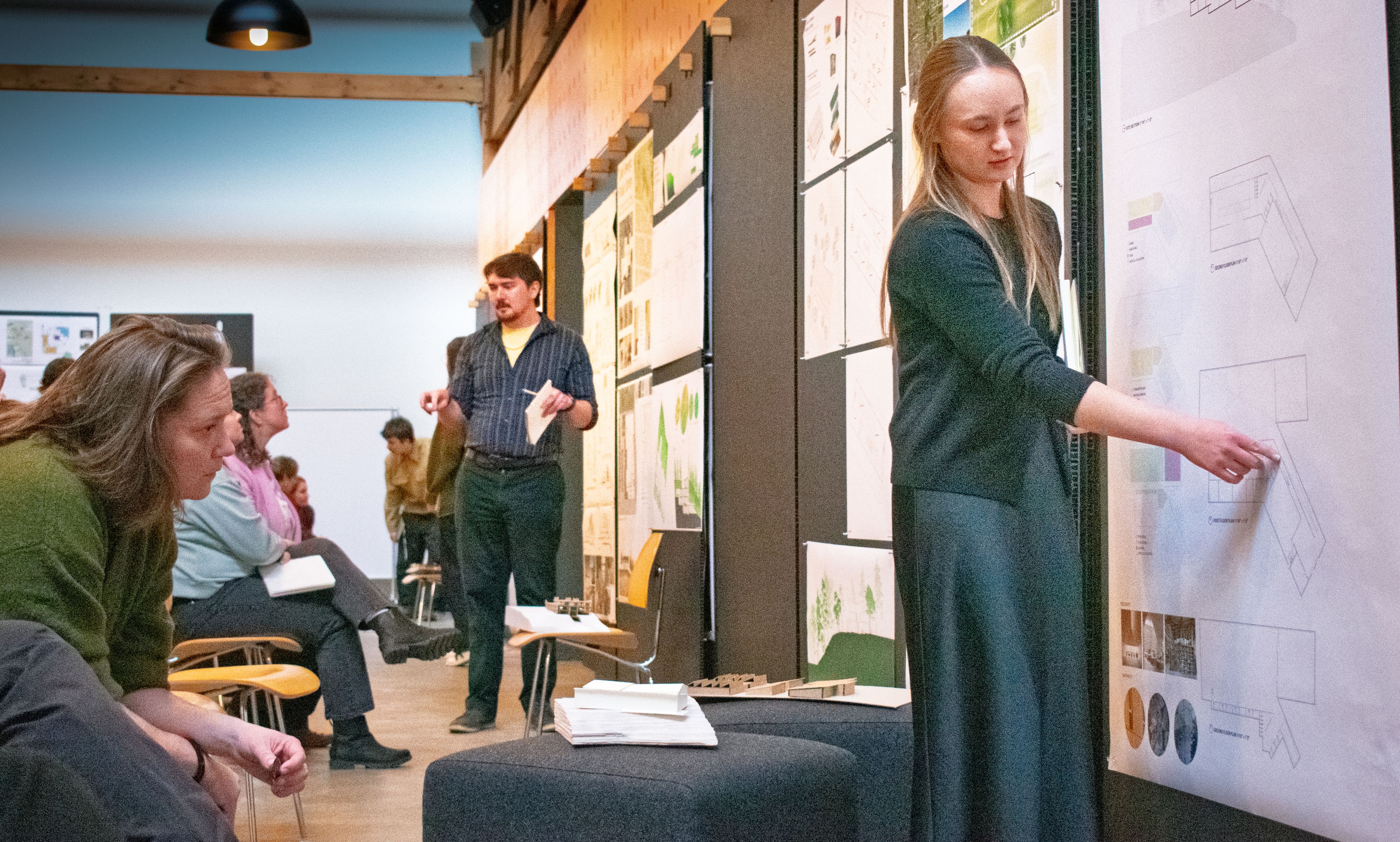
Students present during the midterm review at the Bora Architecture & Interiors office.
Students present during the midterm review at the Bora Architecture & Interiors office.
INDUSTRY ACCESS BUILT IN
What made the Library Design Studio distinctive is not just the subject matter, but the depth of professional access woven into every week of the quarter. Bora brought in rotating guest experts — sustainability directors, mass timber specialists, landscape architects — who shared their knowledge and conducted individual desk visits with each student. Field tours took students to four library branches: recently renovated Holgate and Albina and older Lake Oswego and Vancouver, where students met with the library directors and staff who work in them every day.
The visit to the Albina library left a particular impression on Alvarado. He was captivated by the building’s structural ingenuity — a mass timber frame, raised access floors that concealed mechanical systems while keeping ceilings clean, and two wings set at different elevations. “I can’t imagine the challenge it must have been,” he said.
“Once we saw what students were interested in, we invited people from different firms into the studio,” said Lai, a principal at Bora and studio instructor. “We like to share those experiences and offer students different exposure.”
Alvarado was struck by the dynamic between the two instructors. “Jeanie was design-focused and onboard with unconventional decisions. Becca was more focused on the logistics and how this place would function,” he said of Becca Cavell, an architect at Bora who co-led the studio. “They did a fantastic job of not contradicting each other but brought feedback from their different lenses.”
Cavell said the studio was designed to give students the experience of working at a firm. “We had students build models, print out drawings, work with their hands, experience and implement feedback and find their voice. We wanted to model that culture for them.”
For prospective students, this means entering a program where professional relationships are built in. “The more firms are exposed to our students, the more they hire our students,” Fowler said. “Architecture is an intensely competitive field, and relationships matter enormously.” Internships and classroom experiences with professionals, he notes, are where reputations are built.

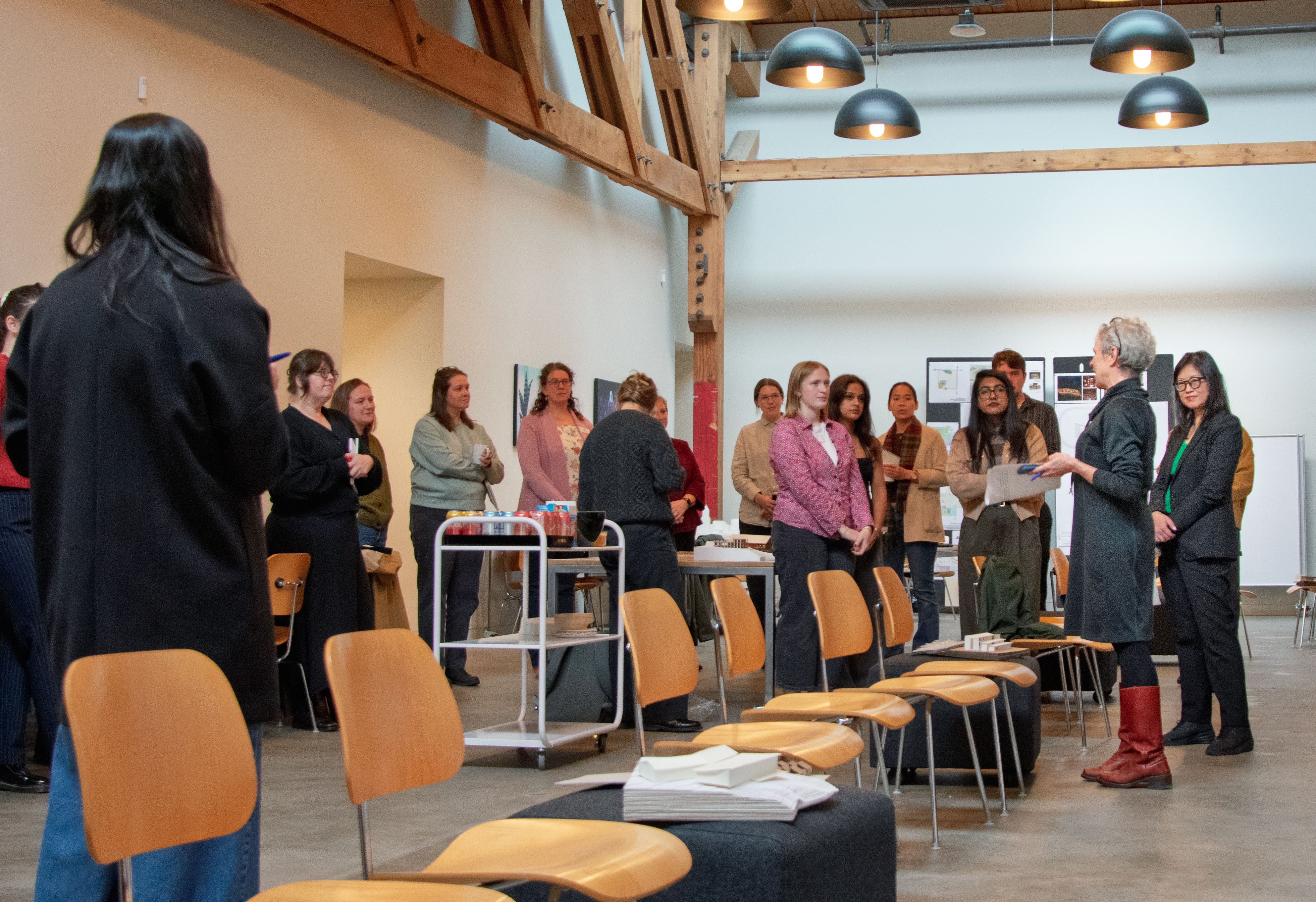
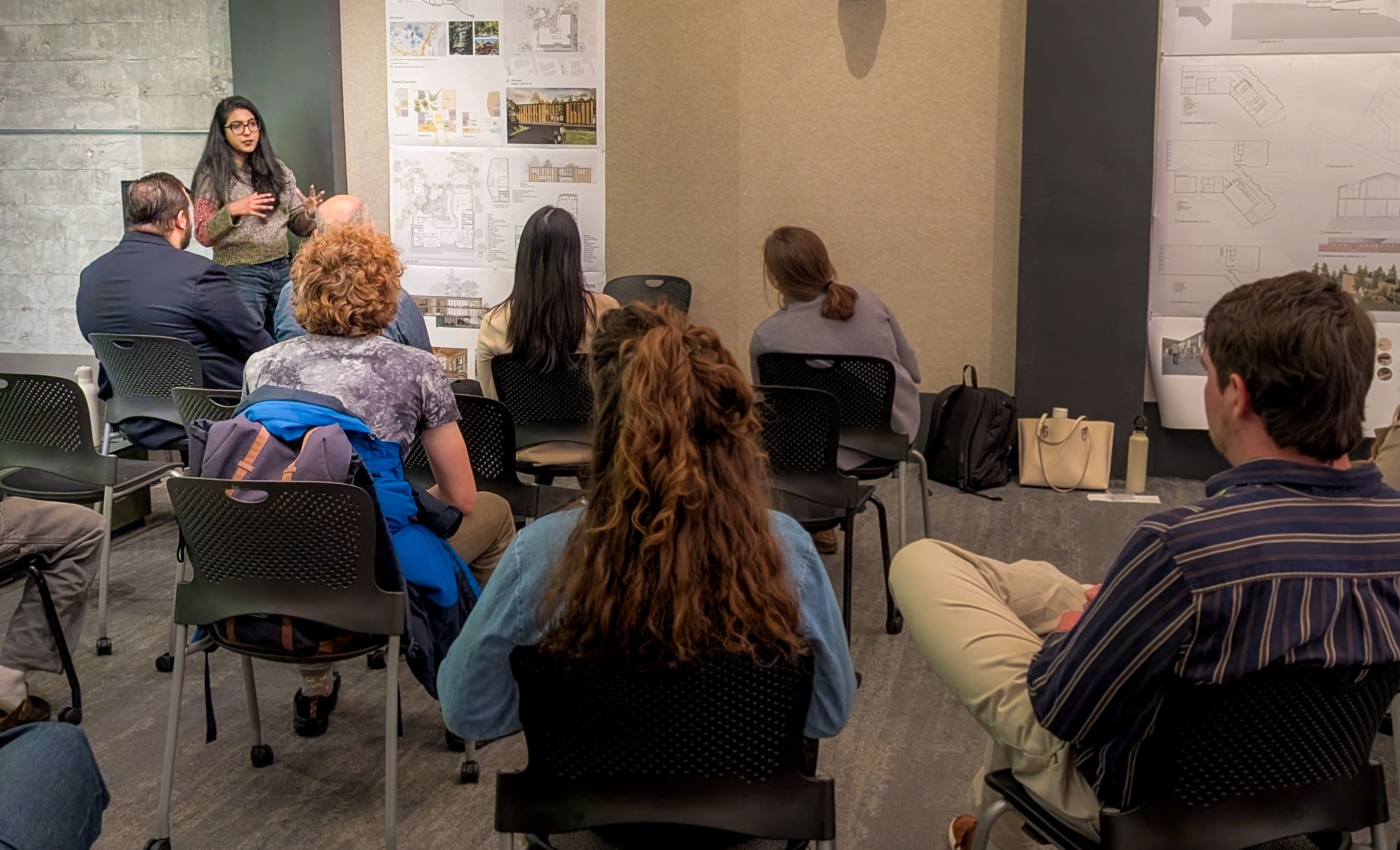
Students and design professionals listen to introductions by Jeanie Lai, far right, and Becca Cavell, second from right, during the midterm review at Bora.
Students and design professionals listen to introductions by Jeanie Lai, far right, and Becca Cavell, second from right, during the midterm review at Bora.



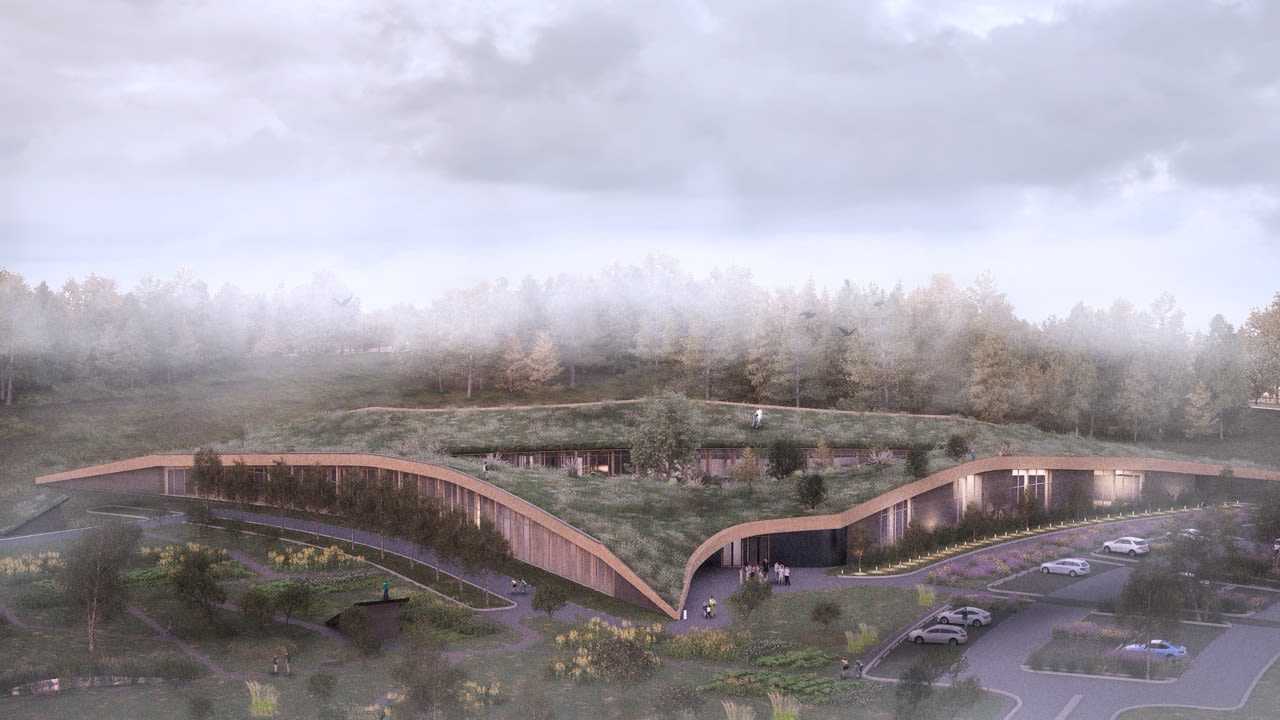
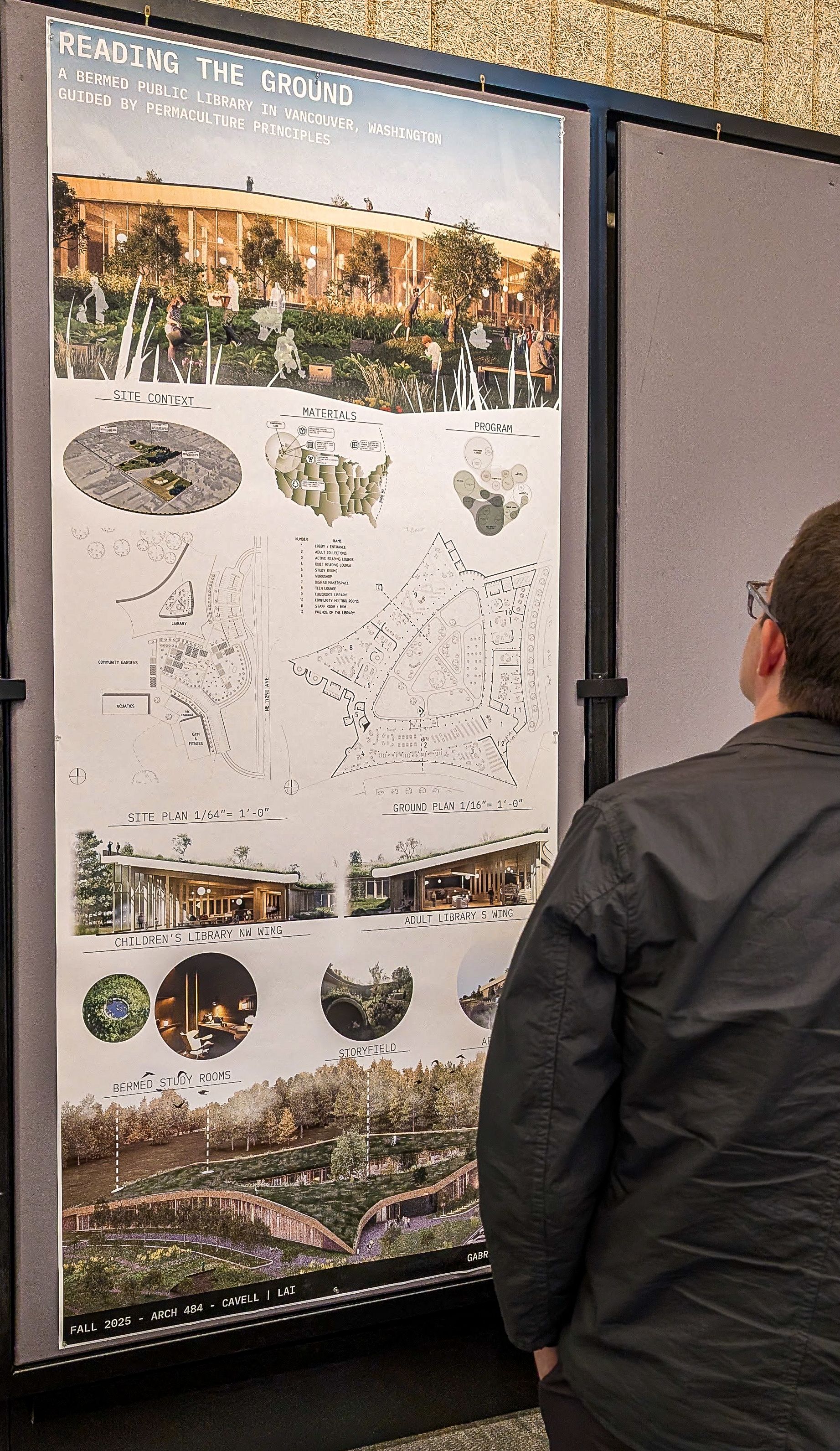
A living roof. A rolling hill. A library. Gabriel Alvarado's final rendering for the Library Design Studio.
A living roof. A rolling hill. A library. Gabriel Alvarado's final rendering for the Library Design Studio.
PORTLAND AS A CLASSROOM
“Portland punches well above its weight when it comes to cities known for design,” Fowler said. The program’s location in Portland is itself a curriculum. The city’s design community is unusually collaborative for its size, shaped by a culture of cross-firm knowledge sharing and a deep, long-standing commitment to civic work.
“Firms here are on the cutting edge of community-engaged design,” Fowler said, pointing to practices like trauma-informed design and community visioning processes that treat design as an ongoing negotiation rather than a finished product. “That’s where better results come from because the users were part of the process. People must live in these buildings. Buildings must be used and loved. Our students benefit from learning that way of practicing design and social engagement.”
Modern library design, said Lai, is about telling community stories, which is a sharp departure from the cookie-cutter models of the past. That philosophy shapes the studio’s culture. Students are encouraged to challenge assumptions and take risks. “This is your opportunity to get experimental,” said Cavell. “Be bold.”
Alvarado took that charge seriously. His library design centered on a rural site, where the building dissolves into the landscape: a living roof that continues from an adjacent nature park, a rounded form that gives the impression of a rolling hill. Inside, mass timber fills the space with warmth and light. “The biggest factor by far is the quality of the instructors,” he said of his choice to come to UO Portland. “Almost all of them are actual working architects. They are so brilliant, extremely talented, and they give a lot of freedom, which allows the creative environment to be diverse.”


From Intern to Professional
Kim Nichols came to architecture as a second career, having worked as a scientist before the pandemic pushed her to reimagine her professional path. After a foundational year in Eugene, she transferred to the UO Portland campus — drawn by its deep integration with the city’s design community.
“The architecture program is very integrated with modern design firms in Portland. The technical classes in the program are helpful in building the foundation of spatial composition, abstract art, facades, and building science. I use a lot of that in my work at Bora. The professors here care deeply about the craft and the details and how the building comes together,” Nichols said.
Her introduction to Bora Architecture and Interiors began at a UO career fair, where she handed over her portfolio and landed an internship. Three months at the firm — rotating through all of Bora’s project types — gave her a breadth of exposure rare for an intern. She stayed on part-time while finishing her degree, and when Bora posted a full-time position shortly before graduation, saying yes felt like a natural continuation.
“The architecture program at UO Portland pushes us to think beyond the traditional role of the architect. We need to think deeply about the impact of our building, how we engage culturally with the community and build buildings that people will love and want to take care of for 100 years.”

ABOUT THE UO PORTLAND ARCHITECTURE PROGRAM
Portland is a dynamic urban laboratory where rapid urbanization, climate change, socio-economic inequity, and public health pressures demand bold, ecological approaches to design. Working across scales — from material performance and adaptive reuse to the design of social infrastructures — the program advances a dialogue about the future of the city and the systems that shape it.
Research is central to that mission. UO programs including the Institute for Health and the Built Environment, the TallWood Design Institute, and the Urbanism Next Center are active in Portland, offering students opportunities to work on cutting-edge applied research on building performance and urban resiliency.
MArch II and MS candidates can complete their degrees entirely in Portland. MArch I and BArch candidates begin in Eugene and are eligible to transfer to Portland to complete their degree requirements.
The University of Oregon has been part of the fabric of Portland for nearly 150 years. Now anchored in the Concordia neighborhood of Northeast Portland, the UO Portland campus brings together graduate and advanced undergraduate programs in design, business, architecture, children's behavioral health, law, journalism, and more.
The campus is home to cutting-edge maker spaces, active research centers, and a vibrant community of students, faculty, and neighbors. The campus has student housing, recreation opportunities and is a short drive to downtown or The Portland International Airport.